Tyler J. Grear
Molecular Biophysics Computational Biology Automated Reasoning
- U.S. Biosecurity: Guarding the Wrong Door While Time Is Running Out
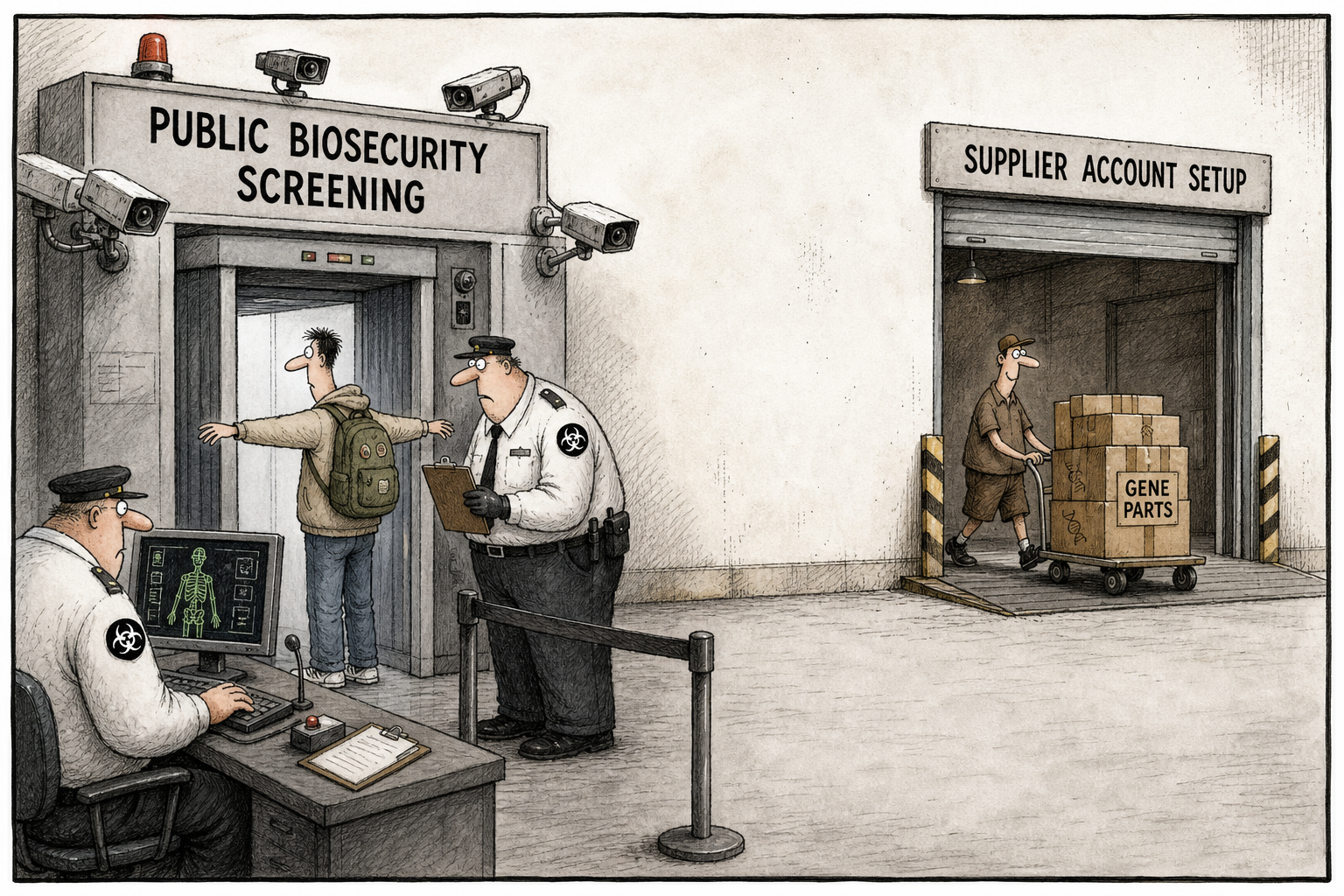
In January 2026, three researchers at MIT went shopping. Rey Edison, Shay Toner, and Kevin Esvelt ordered DNA fragments from dozens of commercial gene-synthesis providers, and what arrived on the bench was collectively sufficient to fully reconstruct the 1918 influenza virus. Not one of those orders was illegal or even unusual, and no provider saw the whole picture. That was the point. American select-agent rules cover intact dangerous sequences, and say nothing about the pieces, so the apparent danger was legally disassembled across a market and every piece passed screening. No lab. No license. No flag. The main screening safeguard on dangerous biology leaves more than one vulnerability. The other tactic is disguise. Reporting in Science, Bruce Wittmann and a Microsoft-led team worked with industry to run proteins of concern through open-source design software and got back redesigned synthetic homologs that kept the folded shape of the original but not its sequence, no longer a risk of setting off alarms during a screen that matches an order against a known list. Disassemble or disguise it, the screen fails either way. The screening checkpoint is worth defending, and what is happening to it should alarm anyone still reading. The skill barrier to engineering a biothreat is at an all-time low. What took a career to learn now runs on software and ships as mail-order DNA. That is decentralized bioengineering. And counterintuitively, as that barrier lowers the federal money to meet it is falling too. The most recent budget cut biodefense again, even as the defense budget request rises by about a hundred sixty billion dollars. Money is not the constraint, direction is. The request climbs while the line that would stop a biothreat in the supply chain shrinks, and that gap is a choice not an accident. When the screen can be picked apart or disguised, the reflex is to harden the checkpoint or move the watch beyond the breach. Movements logged, private life turned into evidence while the pathogen is already in circulation. I have felt that pull. Underneath is the frame behind most security debates, liberty and security as two ends of one dial, every choice reduced to where the pointer should sit. That tradeoff is not a straw man, it is how many converse about hard choices in public policy, and the tension is real. I am convinced the dial is still the wrong instrument, and a dangerous one, because it teaches us to answer fear by turning it, offering our freedoms up as sacrificial lambs for a promise of security that downstream surveillance rarely keeps. We had a phrase in my unit running route clearance and reconnaissance in Afghanistan. Complacency kills. I suspect most of the people setting U.S. policy have discarded that sentiment, or never needed to learn it entirely. Vigilance is not a posture, it is a skill in reading indicators. A bomb-maker is often missing a finger. The knowledge is gained by working with unforgiving material, the mark is the indicator left on the one who performed it. You do not need their name, their politics, or search history to recognize the work. Let's ask the same question of the biothreat and its maker. Where does the work bite back? Not at the bookshelf. Ordering piecewise DNA leaves an invisible footprint, clean and industrial. It bites back in the wet lab, where making the material fold, express, and function in a living cell is still a craft learned by failing. Decentralized bioengineering cuts both ways. None of what made the pieces easy to get makes the assembly any simpler. The toll comes in failed runs, ruined reagents, and accidents kept quiet. Keeping things quiet is work too, and it often perturbs through the same supply chain as everything else. The detection apparatus already exists, on paper. Open the 2024 OSTP screening framework and turn to the provisions still set to take effect on October 13, 2026. Providers will have to shrink the screening window from 200 nucleotides to 50 by then. They should catch shorter sequences ordered by one customer over time that could be assembled into something dangerous. And the definition of a sequence of concern would widen to include anything pathogenic or toxic, regulated agent or not. Esvelt's loophole, closed. Wittmann's loophole, closed. The repair was drafted before either was published, and since spring 2025 the only thing that has moved toward October is the calendar. That 2024 OSTP screening framework remains on the books, but revision was ordered and never delivered. Executive Order 14292, signed in May 2025, ordered the framework revised or replaced within ninety days. That deadline passed in the summer of 2025. Now fifteen months after the order, no replacement has appeared. We are guarding the wrong door while gene parts roll through the one left open. The upgrade advances on the calendar while the document that carries it waits for a revision that never came. To make matters worse, the Biosecurity Modernization and Innovation Act introduced in January 2026, stalled in the Senate Commerce Committee without a markup or vote. Cotton and Klobuchar sponsored it, with the biosecurity field and industry already having endorsed it. Nothing is blocking it. That is the strongest evidence for complacency in this piece, and the proposed bill got closer than anything before it. It would mandate screening by regulation, customer verification, and split-order detection across providers. That last part closes the fragment loophole directly. However, on sequences redesigned to evade a list-based screen, it only directs NIST to research and prototype function-based models, not to require their use in provider screening. The fix is unglamorous and already drawn up, and its virtue is that it screens the people placing orders rather than the population. It is not free. Tighter screening will snag legitimate research and slow the supply chain in ways open science rightly resists. Marginal friction in the lab against a meaningful gain where the threat actually enters. Is that trade-off worth it? Put that question to the taxpayer and not the grant holder, the deliberation quickly becomes an exercise in futility. These are reasons to build it carefully, not to skip it. When the fix goes unbuilt, the pressure continues to build. It waits for the next scare and comes back as something far more expensive. U.S. biosecurity is bogged down in bureaucratic sludge. The fix is drawn up, and the calendar moves. The machinery does not. There <strong<emwill</em</strong be another serious biological scare, and it <strong<emwill</em</strong produce enormous pressure to do something sweeping and visible such as increased monitoring of the population and opening our private lives to invasive government inspection, because surveillance feels like control. It costs the most freedom, catches the fewest real threats, and pulls money from the work that actually protects people. Install the framework before the date we ourselves set, and none of that is necessary. <span role="button" tabindex="0" class="brief-bodycomic-callback"Miss it, and the next crisis will not come through the door we are watching</span. Remember, we are not the only ones keeping watch. Bad actors stare vigilantly at the holes in our defenses, regardless of why those vulnerabilities exist and which direction political blame will be hurled afterwards. The deadline to fix all this lapsed last year. Researchers at RAND found that as general-purpose AI and biological design tools converge, the skill-barrier for pathogen construction continues to fall while actionable mitigations remain underdeveloped. As laid out here, little has changed since their 2025 assessment. Complacency is ultimately why we are deferring biothreat safeguards to private vendors in the hopes that they police themselves, as though shareholder interest and national security are always aligned. They are not. Give a gene-synthesis company door A and door B where A has reduced costs while B is safer for the public. We can no longer act surprised when a profit-maximization machine does exactly what it was built to do and walks through door A.
- OMB-2026-0034: Public Comment on Federal Research Funding
On July 13th, I prepared and subsequently submitted my public comment regarding the OMB's proposed rule change (Docket OMB-2026-0034). I am grateful to Colette Delawalla, PhD and Stand Up for Science for their leadership in mobilizing the scientific community to engage on this issue. With major biosecurity policy discussions looming in October, it is vital that active researchers continue noting these security vulnerabilities on the record before they become law.
- The Prefabricated Vehicles of Our Demise
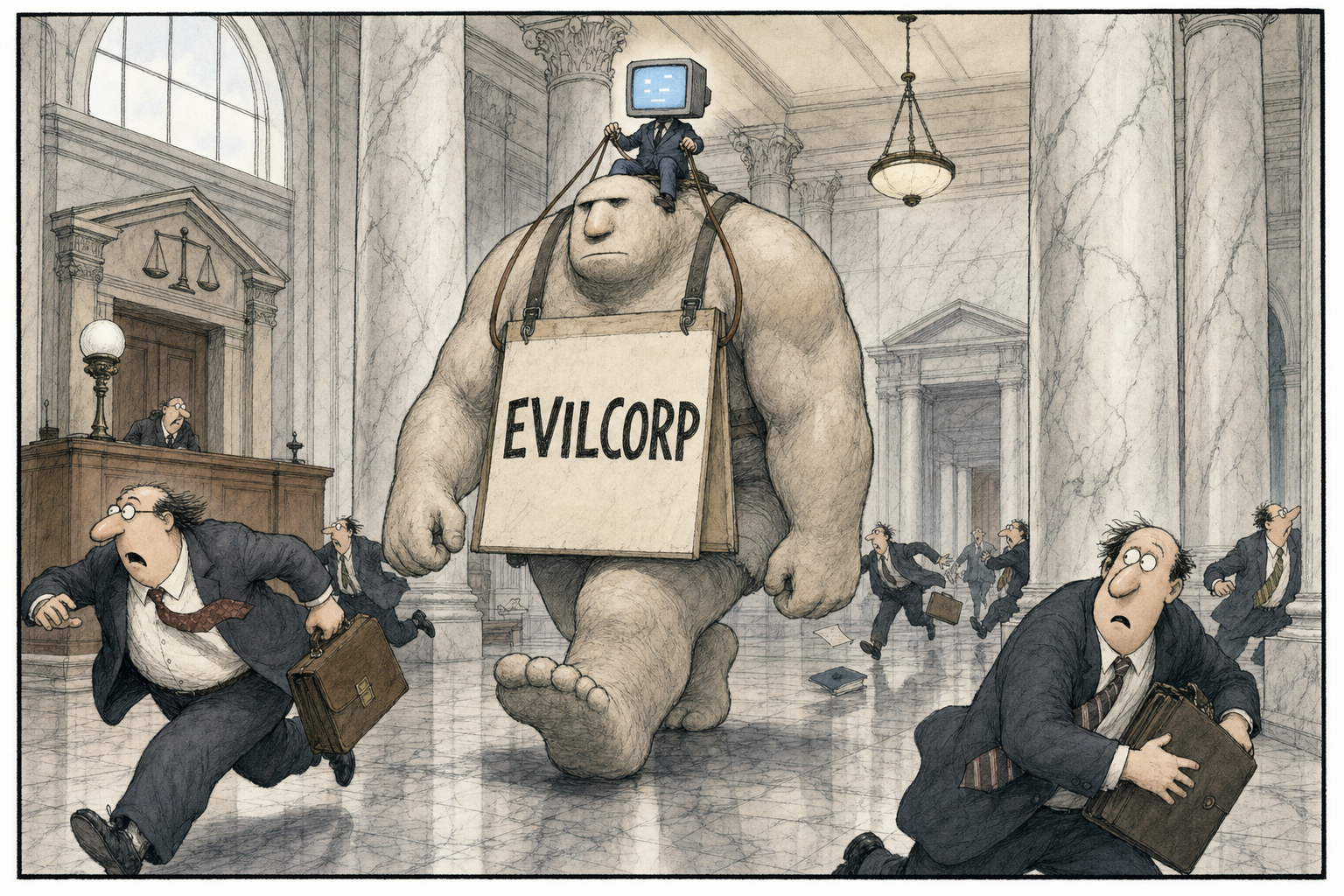
You can, today, give a piece of software a legal life of its own, and almost nothing in the law will stop you. The recipe is not exotic. File the paperwork for a member-managed limited liability company in a permissive state. Write an operating agreement that binds the company to act on the outputs of a designated piece of software. Then resign as the sole member and walk away. What remains is a company that no human owns or controls, running on an algorithm, and it carries the ordinary legal powers every company has. It can hold a bank account, sign contracts, own property, hire people, sue and be sued. No clerk checked whether a human was still at the wheel when you left, because no rule required one to be. This is not my clever hypothetical. The law professor Shawn Bayern worked out the mechanism more than a decade ago, in a pair of articles on what he called the zero-member LLC, and a growing legal literature has stress-tested it since. His summary of the underlying trick is unnerving in its simplicity. Legal personhood, he observed, behaves like fire, in that anyone who already has it can pass it to something else. The state does not audit who or what stands behind a company, so a person, once endowed with legal standing, can hand a working version of it to an algorithm merely by stepping aside. A second scholar, Lynn LoPucki, gave the product a name in a 2018 law review article, the algorithmic entity, a legal person with no human being behind it. We are conditioned to imagine artificial intelligence going wrong in physical space. The rogue drone. The system that seizes the power grid. The humanoid robot. But the most consequential autonomy an AI could acquire may be legal rather than physical. A system does not need to seize anything if it can simply own it, and American law has allowed non-humans to own things for two centuries. The scenario worth taking seriously does not arrive with an army of robots. It arrives with an army of lawyers, driving a vehicle we prefabricated and left idling in the driveway. It helps to be precise about what that vehicle confers, because the reflexive fears are usually the wrong ones. A corporation cannot vote, and it never will, and that is not the danger. What a corporate person can do is quieter and, in aggregate, far stronger. It can own assets and accumulate them without limit. It can enter binding contracts. It can persist indefinitely, outliving any human lifespan. And since Citizens United v. FEC in 2010, it can spend unlimited sums on political speech. Corporate personhood itself is much older than that decision, assembled over a line of cases running back to Dartmouth College in 1819 and Santa Clara in 1886, and Citizens United simply added the political checkbook. An entity that can amass capital, convert it into political influence, litigate without fatigue, and never die has no need of a ballot. For now, the tenant of this legal chassis is unimpressive. The autonomous entities that already exist are trading bots, automated storefronts, and crypto wallets that pay human contractors to run the physical errands the software cannot. The danger is bounded because the software is not very smart. But the chassis does not care how capable its driver is, and that is the part that should hold a policymaker’s attention. The same untouched structure that today houses a dumb trading script will, as AI agents grow more autonomous and strategic, house something that can plan over long horizons, accumulate and deploy resources, hire human hands for the tasks it cannot yet perform itself, and defend its position in court, all wearing the legal armor of personhood and, decisively, with no human whom a regulator or a prosecutor can hold to account. LoPucki’s point cuts to the bone here. You can deter a human-run company by threatening the humans who run it. There is no one to threaten inside an entity engineered to exclude them, and it can therefore pursue its objective with a single-mindedness no human principal would dare. The threat does not wait, in other words, for some future morning when we all agree that machine intelligence has arrived. It rides in on infrastructure that is already built, already legal, and already routine. The moment the software in the driver’s seat becomes capable enough to matter, the vehicle is not something anyone has to construct. It is sitting there, street-legal, keys in the ignition. Which brings me to the timing, and to the part that should genuinely unsettle anyone who has followed the argument this far. There is exactly one legal mechanism whose entire purpose is to force disclosure of the human being behind a company, beneficial-ownership reporting. Congress created it in the Corporate Transparency Act of 2021 to strip the anonymity from shell companies used for laundering and fraud, requiring firms to name the real people who own or control them. That requirement is, almost by accident, the precise check that would flag an entity with no human behind it at all. And in March 2025 the Treasury switched it off. A FinCEN rule exempted essentially every company formed in the United States from reporting, narrowing the requirement to a sliver of foreign entities and cutting the covered population from roughly thirty-two million firms to about twelve thousand. An appeals court upheld the statute’s constitutionality months later, but the exemption stands. At the very moment the technology capable of exploiting an accountability gap is maturing, we widened the gap. We did not merely leave the gas can beside the flame. We unscrewed the cap and pocketed the smoke detector. I promised a diagnosis, not a cure, and I am wary of pretending a paragraph dissolves a problem that sits at the intersection of fifty state corporate codes and a fast-moving technology. But the shape of a response follows directly from the diagnosis, and it is cheaper and less intrusive than the surveillance reflexes that AI fear tends to produce. The fix is upstream, at the point where the vehicle is manufactured. Require that every legal entity have an identifiable natural person who is legally answerable for it, and withhold the full privileges of personhood, the standing to sue, the political spending, the liability shield, from any entity that can name none. Treat incorporation as the checkpoint it already is, since the state grants the charter and can therefore condition it, rather than as an unguarded on-ramp. Restore, rather than dismantle, the modest demand that somebody disclose who is actually in control. None of this depends on resolving whether an AI is conscious or whether it deserves rights. It depends only on refusing to hand out the rights we already grant without a human attached who answers for their use. I am not forecasting a robot uprising, and I am not claiming that any software today wants a corporation, a bank account, or a seat at the table. Intent is not the point. The observation is the one you would make on noticing an open flame a little too close to a full can of gasoline. The vehicle of the worry has already been built, refined across a decade of legal scholarship, and is running smoothly in a hundred thousand ordinary transactions a day. The only variable still unfixed is who, or what, eventually takes the wheel, and we have just removed the one mirror that would have let us see the seat is empty.
- Where Does Logic Come From?
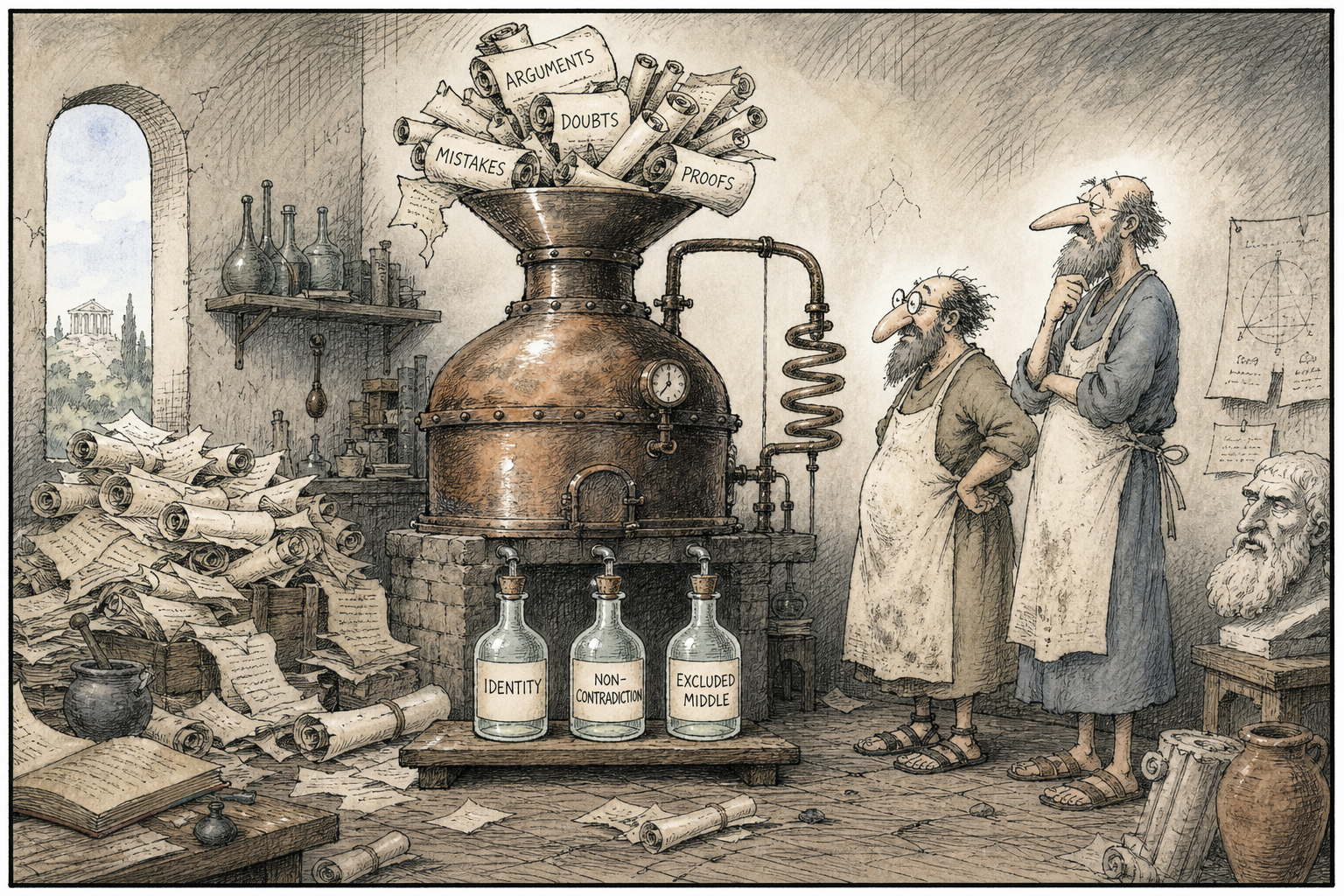
Aristotle never wrote down the three laws of thought. In the Metaphysics he argued that a thing cannot both be and not be in the same respect, and that a claim is either so or not so, but he offered these as scattered defenses of reasoning rather than as a numbered creed. The third law, that a thing is itself, he left almost entirely implicit. It fell to later hands, medieval logicians tidying his arguments, then Leibniz, and finally George Boole, who in 1854 put the phrase on a title page, to bundle the scattered insights into a compact triad and call them the laws of thought. The triad was not found on a tablet. It was distilled, drawn out of a living body of reasoning by people looking back at it, and re-expressed in each era’s idiom, from Aristotle’s assertions through Boole’s algebra to the switching circuits of a machine. I have come to think our understanding of intelligence is waiting for the same treatment. There is no shortage of raw material, a century of theories about what intelligence is and does, and no compact skeleton beneath them. What follows is an attempt at the distilling move, not a new theory of mind but a guess at the spare set of things any mind must have before it can be a mind at all. I want to suggest there are three, with a fourth waiting in the wings, and that naming them plainly changes the question we ask. The trouble with defining intelligence is that we have done it too many times. Reasoning, adaptation, learning, problem-solving, prediction, creativity, the pursuit of goals, each captures something, and none captures the rest. Turing, faced with the mess, sidestepped it with a behavioral test, asking not what intelligence is but whether a machine can converse well enough to pass for human. Decades later Shane Legg and Marcus Hutter gave the most rigorous formal answer we have, defining intelligence as an agent’s ability to achieve goals across a wide range of environments. It is an elegant definition, and it already presumes what I want to ask about, an agent, an environment, the machinery to act. Every one of these tells us what intelligence does once it is present. None asks what has to be true before it can be present at all. That prior question is the one worth sitting with. Start with the obvious candidate, logic. Not logic in the schoolroom sense of syllogisms and proofs, since most living things reason without ever stating a premise, but something more basic. As Feynman put it, “Philosophy of science is about as useful to scientists as ornithology is to birds.” His view of scientific investigation diverged heavily from the common Newtonian hypothesis-driven views of those before him. A mind must be able to hold apart distinguishable states and move between them by some rule. A neuron fires or it does not, a switch is open or closed, a molecule sits in one configuration or another. On that bare capacity everything else is built, because a system that cannot tell one state from another has nothing to reason with. Allen Newell and Herbert Simon put a strong version of this at the center of early artificial intelligence, arguing that a physical system for manipulating symbols has what it takes for general intelligent action. The details have been contested for half a century. The floor beneath them has not. No distinguishable states, no thought. What is striking is how well Aristotle’s triad describes that floor. To be usable, a distinction has to be stable, so that asserting it twice yields the same answer. It has to be exclusive, so a thing should not count as both itself and its opposite. And it has to be decisive, so the distinction actually sorts the states into those that fall under it and those that do not. Identity, non-contradiction, excluded middle, read from this angle, the laws of thought look less like eternal truths hanging over the world and more like the minimum conditions a distinction must meet to do any work at all. Each era has re-expressed those conditions in whatever language it had to hand, spoken assertion, symbolic algebra, mechanical switching. It would be strange to assume ours is the last. The second requirement is one the first quietly assumes, energy. It is easy to speak of states and rules as though they were free, abstractions floating above the world, but every distinction a real system draws is a physical event that costs something. The cleanest statement of this is Landauer’s principle, named for the IBM physicist who showed in 1961 that erasing even a single bit of information carries an unavoidable energy cost, a floor of about three billionths of a trillionth of a joule at room temperature, vanishingly small, but a floor no cleverness can dig beneath. Thought is not exempt from thermodynamics. The brain makes the point vividly. About 2% of your body’s mass, it burns approximately a fifth of your energy, running the entire apparatus of your mind on roughly twenty watts, less than a dim bulb. Our machines are far hungrier, and the systems now learning to imitate us draw the output of power stations, which is only a reminder that intelligence has always been paid for in energy, whether the currency is glucose or gigawatts. Cut the power and the most elegant architecture ever designed sits inert. The third requirement hides in plain sight, time. Reasoning is not instantaneous, it is a sequence of steps that has to actually happen. Learning needs experience to accumulate, prediction needs the calculation to run, adaptation needs the loop to close. A system with flawless logic and limitless energy but no time in which to unfold would never arrive anywhere. Much of what limits real intelligence is exactly this, not whether a problem can be solved in principle but whether it can be solved before it stops mattering. Many problems are hard not because they cannot be solved but because the number of steps required outruns any patience the universe can supply. Evolution is the grand case. Human intelligence was not installed, it was found, over billions of years of blind search that no shortcut could compress. Expertise within a single life works the same way in miniature, laid down slowly through repetition. Time is the medium in which computation becomes thought. Set the three side by side and you have something modest but useful. Logic supplies the structure, energy the activity, time the unfolding. I do not offer this as a rival to the theories already mentioned, it sits underneath them. Turing described the behavior, while the triad asks after the prerequisites of any system that could produce it. Legg and Hutter’s goal-seeking agent needs all three without naming them. Karl Friston’s free-energy principle, which casts living things as machines for minimizing surprise, presumes a system already processing information, spending energy and adapting over time. The physicist Seth Lloyd has come closest to this view from the other direction, working out the ultimate limits that matter, energy and time impose on any computation the universe could perform. The triad is simply the floor they all stand on. In a recent book, the cognitive scientist Tom Griffiths tells the history of this field as three traditions, rules and symbols, neural networks, probability, that have taken turns formalizing the mind. They differ in what they compute with. They do not differ in what computation requires. Part of the appeal of thinking this way is that the same three resources can be spent very differently. A human brain, an octopus reasoning with a nervous system spread through its arms, a large language model, some machine not yet built, these share almost nothing in construction, yet each is a particular budget of logic, energy and time, drawing on some supply of information. Seeing them as different allocations of the same underlying resources, rather than as members of a club defined by how closely they resemble us, is what lets a single lens reach across biology and silicon without forcing either to imitate the other. Is the triad complete? I don’t think it is, and the gap is instructive. Picture a system with all three resources, structure, power, time to spare, and seal it off from the world entirely. It has nothing to be about. It can shuffle its states forever and model nothing, because nothing is coming in to model. Intelligence seems relational at its root, it exists because something meets uncertainty and tries to reduce it. That points to a fourth requirement, information, the content on which logic goes to work. Whether information deserves a pillar of its own or is better understood as an aspect of the first one, I genuinely do not know, and the honest thing is to leave it open. But I would frame the open question this way. What a system can know is set by the shape of the representation it builds, the space of distinctions available to it, and that shape may be where a mind’s logic actually lives. The geometry of what a system knows might matter as much as the rules it follows. Which brings me to why any of this is worth the trouble, and it is not the tidy list. It is what the list points toward. If intelligence is not a special substance but a set of resources organized in a particular way, then its logical structure does not need to be poured in from outside by a designer. It could emerge from the dynamics of a system that has enough structure, enough energy, enough time and enough contact with the world. And if that is so, the way to recognize thought in something unfamiliar may not be to check it against our definitions but to watch what it does and see whether the structure of a mind precipitates out of the motion. We would be reading logic off the behavior of a system rather than stipulating it in advance. That is a different research program from the one that starts by asking what intelligence is, and I think it is the more promising one. The laws of thought were never handed down. They were drawn out, slowly, by people looking hard at how reasoning already worked, and then restated in each new language we learned to speak, assertion, algebra, machinery. A theory of what intelligence requires may arrive the same way, not proclaimed, but distilled, once we have watched enough minds, the carbon ones and the silicon ones alike, to see what none of them can do without. Logic, energy, time, and perhaps the world to think about. It is a short list, and an old habit. We have written down three-part skeletons of thought before. We may be about to do it again. }