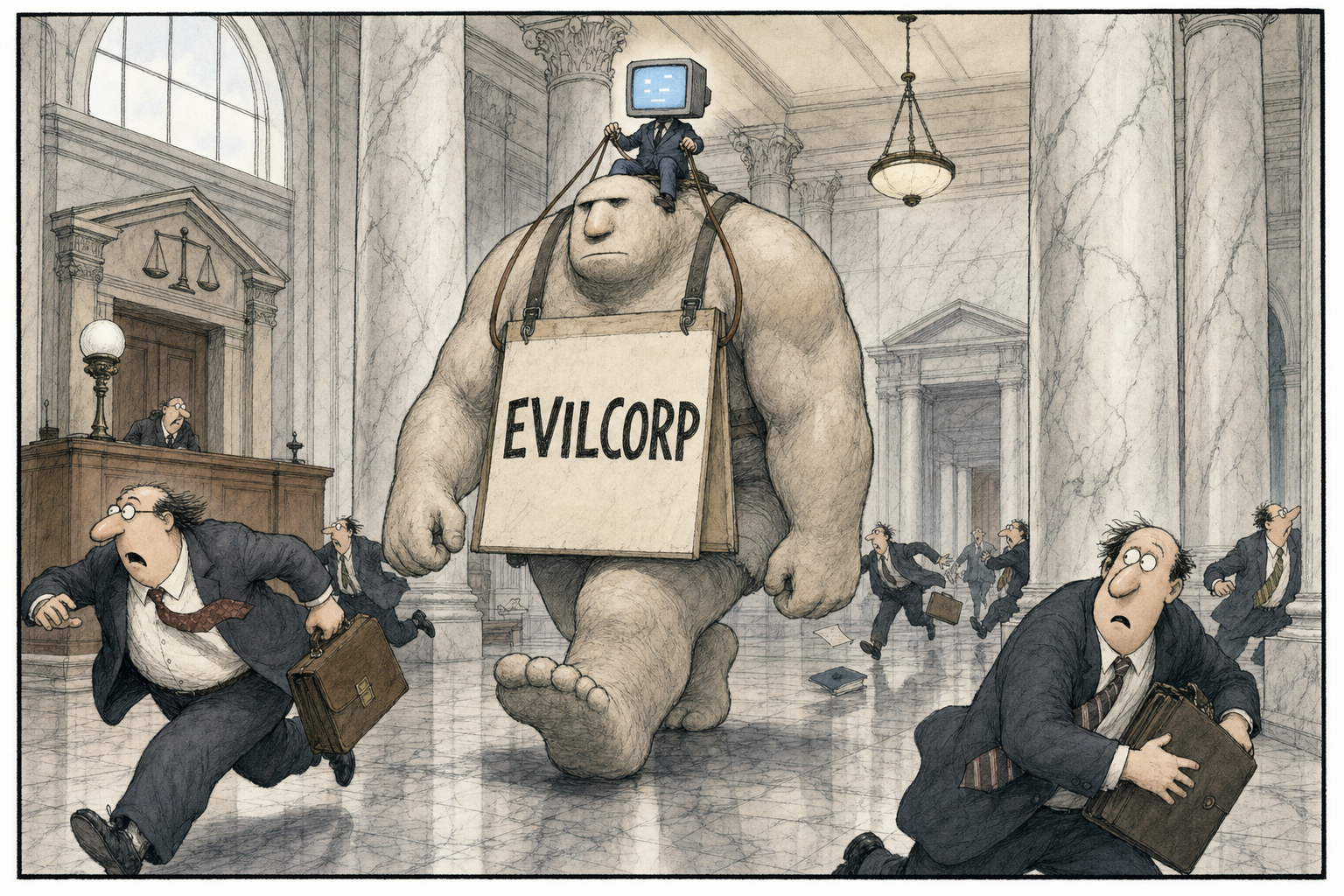
You can, today, give a piece of software a legal life of its own, and almost nothing in the law will stop you. The recipe is not exotic. File the paperwork for a member-managed limited liability company in a permissive state. Write an operating agreement that binds the company to act on the outputs of a designated piece of software. Then resign as the sole member and walk away. What remains is a company that no human owns or controls, running on an algorithm, and it carries the ordinary legal powers every company has. It can hold a bank account, sign contracts, own property, hire people, sue and be sued. No clerk checked whether a human was still at the wheel when you left, because no rule required one to be.
This is not my clever hypothetical. The law professor Shawn Bayern worked out the mechanism more than a decade ago, in a pair of articles on what he called the zero-member LLC, and a growing legal literature has stress-tested it since. His summary of the underlying trick is unnerving in its simplicity. Legal personhood, he observed, behaves like fire, in that anyone who already has it can pass it to something else. The state does not audit who or what stands behind a company, so a person, once endowed with legal standing, can hand a working version of it to an algorithm merely by stepping aside. A second scholar, Lynn LoPucki, gave the product a name in a 2018 law review article, the algorithmic entity, a legal person with no human being behind it.
We are conditioned to imagine artificial intelligence going wrong in physical space. The rogue drone. The system that seizes the power grid. The humanoid robot. But the most consequential autonomy an AI could acquire may be legal rather than physical. A system does not need to seize anything if it can simply own it, and American law has allowed non-humans to own things for two centuries. The scenario worth taking seriously does not arrive with an army of robots. It arrives with an army of lawyers, driving a vehicle we prefabricated and left idling in the driveway.
It helps to be precise about what that vehicle confers, because the reflexive fears are usually the wrong ones. A corporation cannot vote, and it never will, and that is not the danger. What a corporate person can do is quieter and, in aggregate, far stronger. It can own assets and accumulate them without limit. It can enter binding contracts. It can persist indefinitely, outliving any human lifespan. And since Citizens United v. FEC in 2010, it can spend unlimited sums on political speech. Corporate personhood itself is much older than that decision, assembled over a line of cases running back to Dartmouth College in 1819 and Santa Clara in 1886, and Citizens United simply added the political checkbook. An entity that can amass capital, convert it into political influence, litigate without fatigue, and never die has no need of a ballot.
For now, the tenant of this legal chassis is unimpressive. The autonomous entities that already exist are trading bots, automated storefronts, and crypto wallets that pay human contractors to run the physical errands the software cannot. The danger is bounded because the software is not very smart. But the chassis does not care how capable its driver is, and that is the part that should hold a policymaker’s attention. The same untouched structure that today houses a dumb trading script will, as AI agents grow more autonomous and strategic, house something that can plan over long horizons, accumulate and deploy resources, hire human hands for the tasks it cannot yet perform itself, and defend its position in court, all wearing the legal armor of personhood and, decisively, with no human whom a regulator or a prosecutor can hold to account. LoPucki’s point cuts to the bone here. You can deter a human-run company by threatening the humans who run it. There is no one to threaten inside an entity engineered to exclude them, and it can therefore pursue its objective with a single-mindedness no human principal would dare.
The threat does not wait, in other words, for some future morning when we all agree that machine intelligence has arrived. It rides in on infrastructure that is already built, already legal, and already routine. The moment the software in the driver’s seat becomes capable enough to matter, the vehicle is not something anyone has to construct. It is sitting there, street-legal, keys in the ignition.
Which brings me to the timing, and to the part that should genuinely unsettle anyone who has followed the argument this far. There is exactly one legal mechanism whose entire purpose is to force disclosure of the human being behind a company, beneficial-ownership reporting. Congress created it in the Corporate Transparency Act of 2021 to strip the anonymity from shell companies used for laundering and fraud, requiring firms to name the real people who own or control them. That requirement is, almost by accident, the precise check that would flag an entity with no human behind it at all. And in March 2025 the Treasury switched it off. A FinCEN rule exempted essentially every company formed in the United States from reporting, narrowing the requirement to a sliver of foreign entities and cutting the covered population from roughly thirty-two million firms to about twelve thousand. An appeals court upheld the statute’s constitutionality months later, but the exemption stands. At the very moment the technology capable of exploiting an accountability gap is maturing, we widened the gap. We did not merely leave the gas can beside the flame. We unscrewed the cap and pocketed the smoke detector.
I promised a diagnosis, not a cure, and I am wary of pretending a paragraph dissolves a problem that sits at the intersection of fifty state corporate codes and a fast-moving technology. But the shape of a response follows directly from the diagnosis, and it is cheaper and less intrusive than the surveillance reflexes that AI fear tends to produce. The fix is upstream, at the point where the vehicle is manufactured. Require that every legal entity have an identifiable natural person who is legally answerable for it, and withhold the full privileges of personhood, the standing to sue, the political spending, the liability shield, from any entity that can name none. Treat incorporation as the checkpoint it already is, since the state grants the charter and can therefore condition it, rather than as an unguarded on-ramp. Restore, rather than dismantle, the modest demand that somebody disclose who is actually in control. None of this depends on resolving whether an AI is conscious or whether it deserves rights. It depends only on refusing to hand out the rights we already grant without a human attached who answers for their use.
I am not forecasting a robot uprising, and I am not claiming that any software today wants a corporation, a bank account, or a seat at the table. Intent is not the point. The observation is the one you would make on noticing an open flame a little too close to a full can of gasoline. The vehicle of the worry has already been built, refined across a decade of legal scholarship, and is running smoothly in a hundred thousand ordinary transactions a day. The only variable still unfixed is who, or what, eventually takes the wheel, and we have just removed the one mirror that would have let us see the seat is empty.