Where Does Logic Come From?
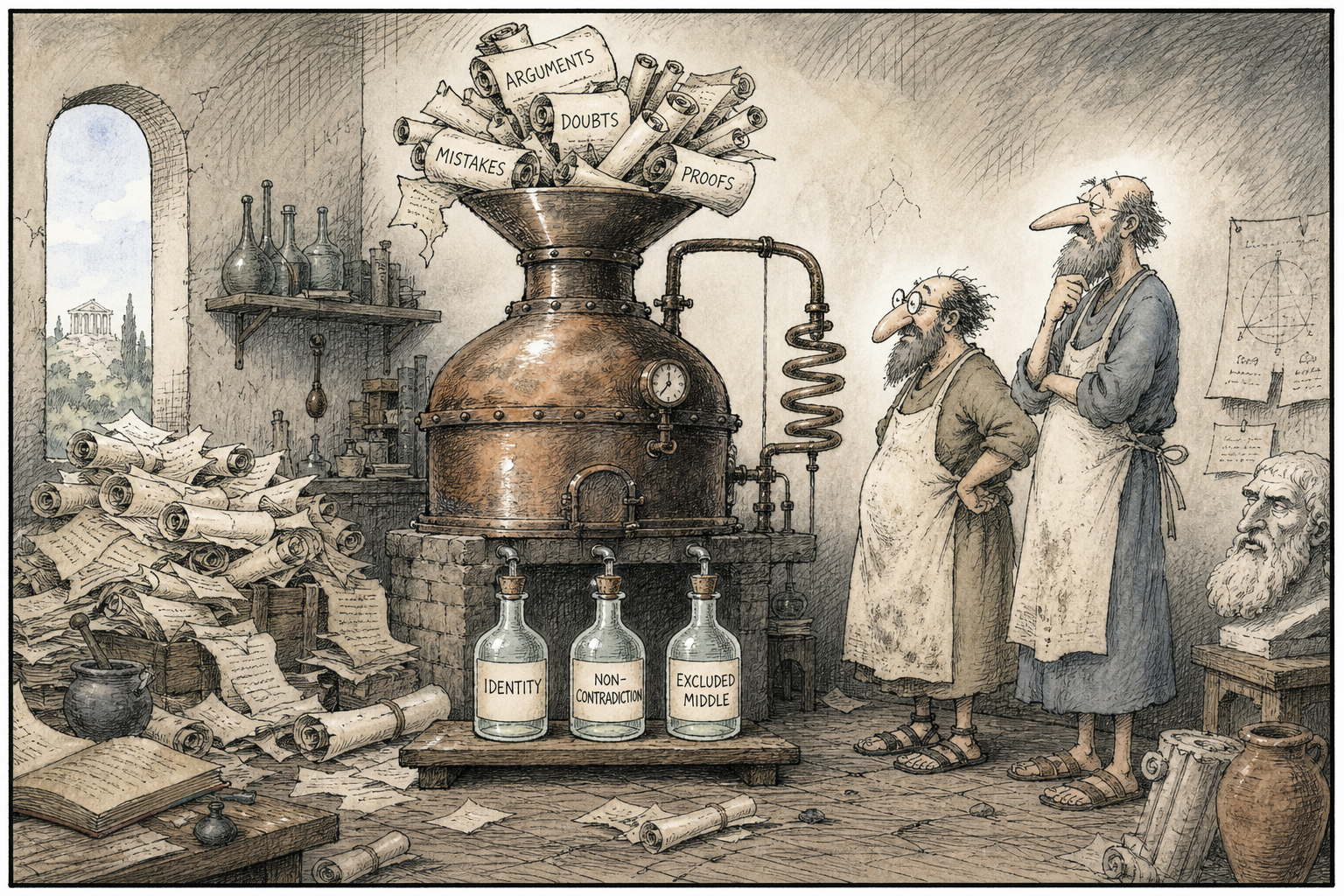
Aristotle never wrote down the three laws of thought. In the Metaphysics he argued that a thing cannot both be and not be in the same respect, and that a claim is either so or not so, but he offered these as scattered defenses of reasoning rather than as a numbered creed. The third law, that a thing is itself, he left almost entirely implicit. It fell to later hands, medieval logicians tidying his arguments, then Leibniz, and finally George Boole, who in 1854 put the phrase on a title page, to bundle the scattered insights into a compact triad and call them the laws of thought. The triad was not found on a tablet. It was distilled, drawn out of a living body of reasoning by people looking back at it, and re-expressed in each era’s idiom, from Aristotle’s assertions through Boole’s algebra to the switching circuits of a machine.
I have come to think our understanding of intelligence is waiting for the same treatment. There is no shortage of raw material, a century of theories about what intelligence is and does, and no compact skeleton beneath them. What follows is an attempt at the distilling move, not a new theory of mind but a guess at the spare set of things any mind must have before it can be a mind at all. I want to suggest there are three, with a fourth waiting in the wings, and that naming them plainly changes the question we ask.
The trouble with defining intelligence is that we have done it too many times. Reasoning, adaptation, learning, problem-solving, prediction, creativity, the pursuit of goals, each captures something, and none captures the rest. Turing, faced with the mess, sidestepped it with a behavioral test, asking not what intelligence is but whether a machine can converse well enough to pass for human. Decades later Shane Legg and Marcus Hutter gave the most rigorous formal answer we have, defining intelligence as an agent’s ability to achieve goals across a wide range of environments. It is an elegant definition, and it already presumes what I want to ask about, an agent, an environment, the machinery to act. Every one of these tells us what intelligence does once it is present. None asks what has to be true before it can be present at all. That prior question is the one worth sitting with.
Start with the obvious candidate, logic. Not logic in the schoolroom sense of syllogisms and proofs, since most living things reason without ever stating a premise, but something more basic. As Feynman put it, “Philosophy of science is about as useful to scientists as ornithology is to birds.” His view of scientific investigation diverged heavily from the common Newtonian hypothesis-driven views of those before him. A mind must be able to hold apart distinguishable states and move between them by some rule. A neuron fires or it does not, a switch is open or closed, a molecule sits in one configuration or another. On that bare capacity everything else is built, because a system that cannot tell one state from another has nothing to reason with. Allen Newell and Herbert Simon put a strong version of this at the center of early artificial intelligence, arguing that a physical system for manipulating symbols has what it takes for general intelligent action. The details have been contested for half a century. The floor beneath them has not. No distinguishable states, no thought.
What is striking is how well Aristotle’s triad describes that floor. To be usable, a distinction has to be stable, so that asserting it twice yields the same answer. It has to be exclusive, so a thing should not count as both itself and its opposite. And it has to be decisive, so the distinction actually sorts the states into those that fall under it and those that do not. Identity, non-contradiction, excluded middle, read from this angle, the laws of thought look less like eternal truths hanging over the world and more like the minimum conditions a distinction must meet to do any work at all. Each era has re-expressed those conditions in whatever language it had to hand, spoken assertion, symbolic algebra, mechanical switching. It would be strange to assume ours is the last.
The second requirement is one the first quietly assumes, energy. It is easy to speak of states and rules as though they were free, abstractions floating above the world, but every distinction a real system draws is a physical event that costs something. The cleanest statement of this is Landauer’s principle, named for the IBM physicist who showed in 1961 that erasing even a single bit of information carries an unavoidable energy cost, a floor of about three billionths of a trillionth of a joule at room temperature, vanishingly small, but a floor no cleverness can dig beneath. Thought is not exempt from thermodynamics. The brain makes the point vividly. About 2% of your body’s mass, it burns approximately a fifth of your energy, running the entire apparatus of your mind on roughly twenty watts, less than a dim bulb. Our machines are far hungrier, and the systems now learning to imitate us draw the output of power stations, which is only a reminder that intelligence has always been paid for in energy, whether the currency is glucose or gigawatts. Cut the power and the most elegant architecture ever designed sits inert.
The third requirement hides in plain sight, time. Reasoning is not instantaneous, it is a sequence of steps that has to actually happen. Learning needs experience to accumulate, prediction needs the calculation to run, adaptation needs the loop to close. A system with flawless logic and limitless energy but no time in which to unfold would never arrive anywhere. Much of what limits real intelligence is exactly this, not whether a problem can be solved in principle but whether it can be solved before it stops mattering. Many problems are hard not because they cannot be solved but because the number of steps required outruns any patience the universe can supply. Evolution is the grand case. Human intelligence was not installed, it was found, over billions of years of blind search that no shortcut could compress. Expertise within a single life works the same way in miniature, laid down slowly through repetition. Time is the medium in which computation becomes thought.
Set the three side by side and you have something modest but useful. Logic supplies the structure, energy the activity, time the unfolding. I do not offer this as a rival to the theories already mentioned, it sits underneath them. Turing described the behavior, while the triad asks after the prerequisites of any system that could produce it. Legg and Hutter’s goal-seeking agent needs all three without naming them. Karl Friston’s free-energy principle, which casts living things as machines for minimizing surprise, presumes a system already processing information, spending energy and adapting over time. The physicist Seth Lloyd has come closest to this view from the other direction, working out the ultimate limits that matter, energy and time impose on any computation the universe could perform. The triad is simply the floor they all stand on. In a recent book, the cognitive scientist Tom Griffiths tells the history of this field as three traditions, rules and symbols, neural networks, probability, that have taken turns formalizing the mind. They differ in what they compute with. They do not differ in what computation requires.
Part of the appeal of thinking this way is that the same three resources can be spent very differently. A human brain, an octopus reasoning with a nervous system spread through its arms, a large language model, some machine not yet built, these share almost nothing in construction, yet each is a particular budget of logic, energy and time, drawing on some supply of information. Seeing them as different allocations of the same underlying resources, rather than as members of a club defined by how closely they resemble us, is what lets a single lens reach across biology and silicon without forcing either to imitate the other.
Is the triad complete? I don’t think it is, and the gap is instructive. Picture a system with all three resources, structure, power, time to spare, and seal it off from the world entirely. It has nothing to be about. It can shuffle its states forever and model nothing, because nothing is coming in to model. Intelligence seems relational at its root, it exists because something meets uncertainty and tries to reduce it. That points to a fourth requirement, information, the content on which logic goes to work. Whether information deserves a pillar of its own or is better understood as an aspect of the first one, I genuinely do not know, and the honest thing is to leave it open. But I would frame the open question this way. What a system can know is set by the shape of the representation it builds, the space of distinctions available to it, and that shape may be where a mind’s logic actually lives. The geometry of what a system knows might matter as much as the rules it follows.
Which brings me to why any of this is worth the trouble, and it is not the tidy list. It is what the list points toward. If intelligence is not a special substance but a set of resources organized in a particular way, then its logical structure does not need to be poured in from outside by a designer. It could emerge from the dynamics of a system that has enough structure, enough energy, enough time and enough contact with the world. And if that is so, the way to recognize thought in something unfamiliar may not be to check it against our definitions but to watch what it does and see whether the structure of a mind precipitates out of the motion. We would be reading logic off the behavior of a system rather than stipulating it in advance. That is a different research program from the one that starts by asking what intelligence is, and I think it is the more promising one.
The laws of thought were never handed down. They were drawn out, slowly, by people looking hard at how reasoning already worked, and then restated in each new language we learned to speak, assertion, algebra, machinery. A theory of what intelligence requires may arrive the same way, not proclaimed, but distilled, once we have watched enough minds, the carbon ones and the silicon ones alike, to see what none of them can do without. Logic, energy, time, and perhaps the world to think about. It is a short list, and an old habit. We have written down three-part skeletons of thought before. We may be about to do it again.